
How should Chicago deal with the city’s persistent financial problems?
That might be the most common question posed to Mayor Brandon Johnson since he took office in 2023.
And his answer has always been a variation on one theme: Hike taxes on millionaires.
So I joined WTTW’s Chicago Tonight to debate whether Johnson is right. You can watch the full debate here.
Discussion around a millionaires tax in Illinois is heating up due to two constitutional amendments introduced in Springfield: HJRCA 21 and HJRCA 26.
If either passes with supermajorities in the House and Senate, and voters approve at the ballot box, the state would impose an extra 3% tax on income over $1 million.
To be clear: these proposals are unlikely to end up on the ballot in November.
But the perennial demand to scrap the Illinois Constitution’s flat income tax requirement is still worth taking seriously. Even the mere discussion of taxes like these can chase away opportunity and investment.
Here are three reasons Illinois lawmakers should reject Johnson’s demand.
Illinois lost nearly 1 million taxpayers on net to migration over the last decade. And those earners took a combined $88 billion in income with them, according to IRS data. It was the second-worst loss of taxpayers in the nation over that time period.
For context, that’s as if the seven largest cities in Illinois outside of Chicago were wiped off the map: Aurora, Joliet, Naperville, Rockford, Elgin, Springfield, and Peoria.
The taxpayers Illinois is losing the fastest? Those earning over $200,000: the highest income bracket published in IRS migration data.
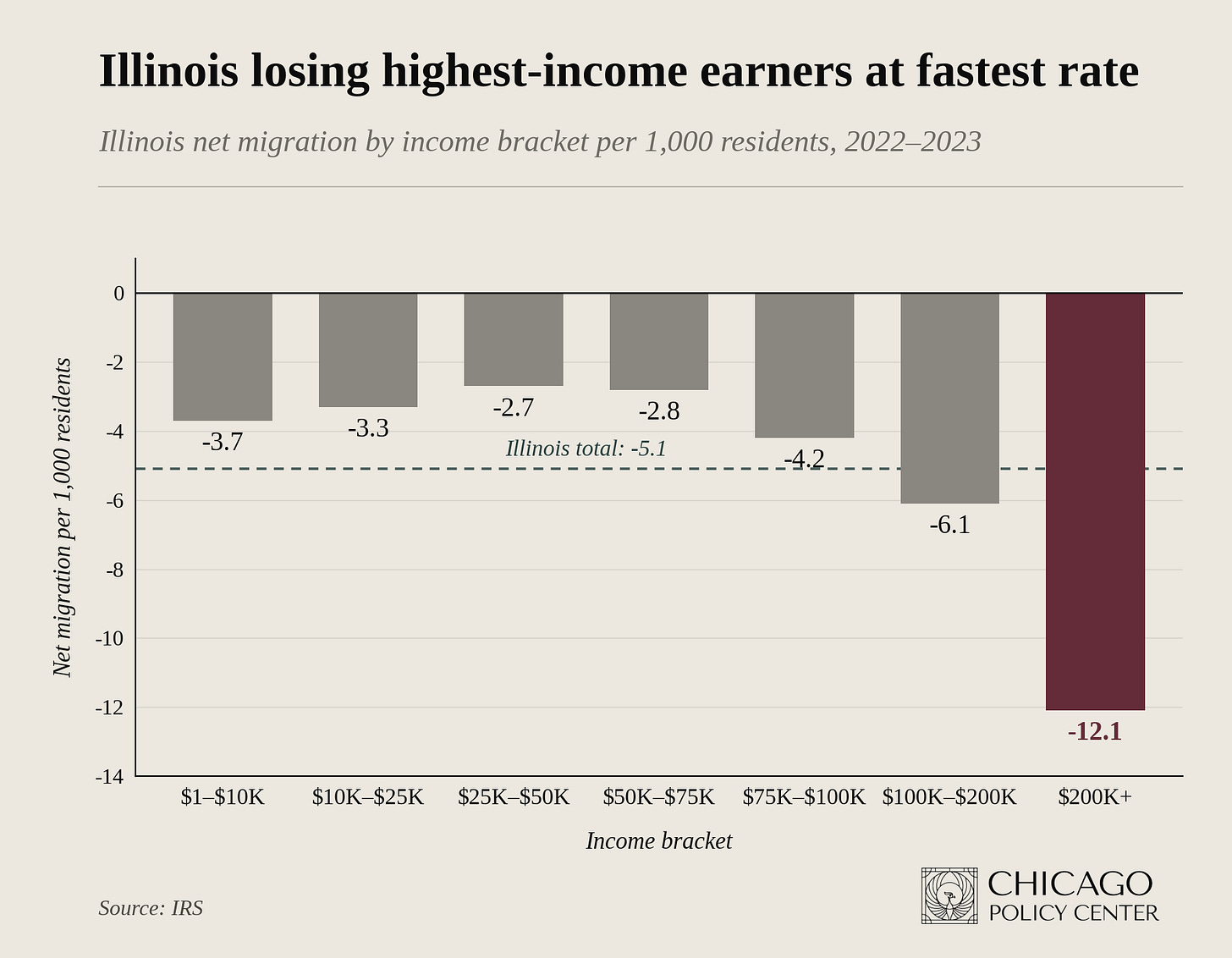
Chicago lawmakers and Gov. JB Pritzker torpedoed Johnson’s “head tax” proposal last year because they understood it would throw up a red flag to those seeking to invest here.
The same argument applies to the millionaires tax. Illinois and Chicago can’t afford to accelerate the loss of higher-income earners. And must do everything in their power to reverse the trend.
Think of it this way: If Illinois simply broke even on migration over the last decade, Chicago and Illinois wouldn’t be staring down budget deficits today.
Small businesses create the overwhelming majority of new jobs in Illinois. In Cook County, businesses with fewer than 20 employees have driven all new jobs growth since the COVID-19 pandemic.
But a “millionaires tax” would hit roughly 22,000 of those Illinois small businesses (S Corps) that take in more then $1 million, hurting hiring and investment across the state.
Meanwhile, large corporations (C Corps) in Illinois would not pay the new millionaire’s surcharge.
Massachusetts passed a new 4% tax on income over $1 million in 2023. New IRS data show in the first full year after that, Massachusetts saw:
-
$4.2 billion in Adjusted Gross Income (AGI) leave the commonwealth, up 8% from $3.9 billion the previous year.
-
70% of that loss came from high-income earners, which is double the share from just a few years earlier.
Most concerningly, total AGI in Massachusetts shrunk year-over-year, meaning higher taxes are hitting a smaller tax base.
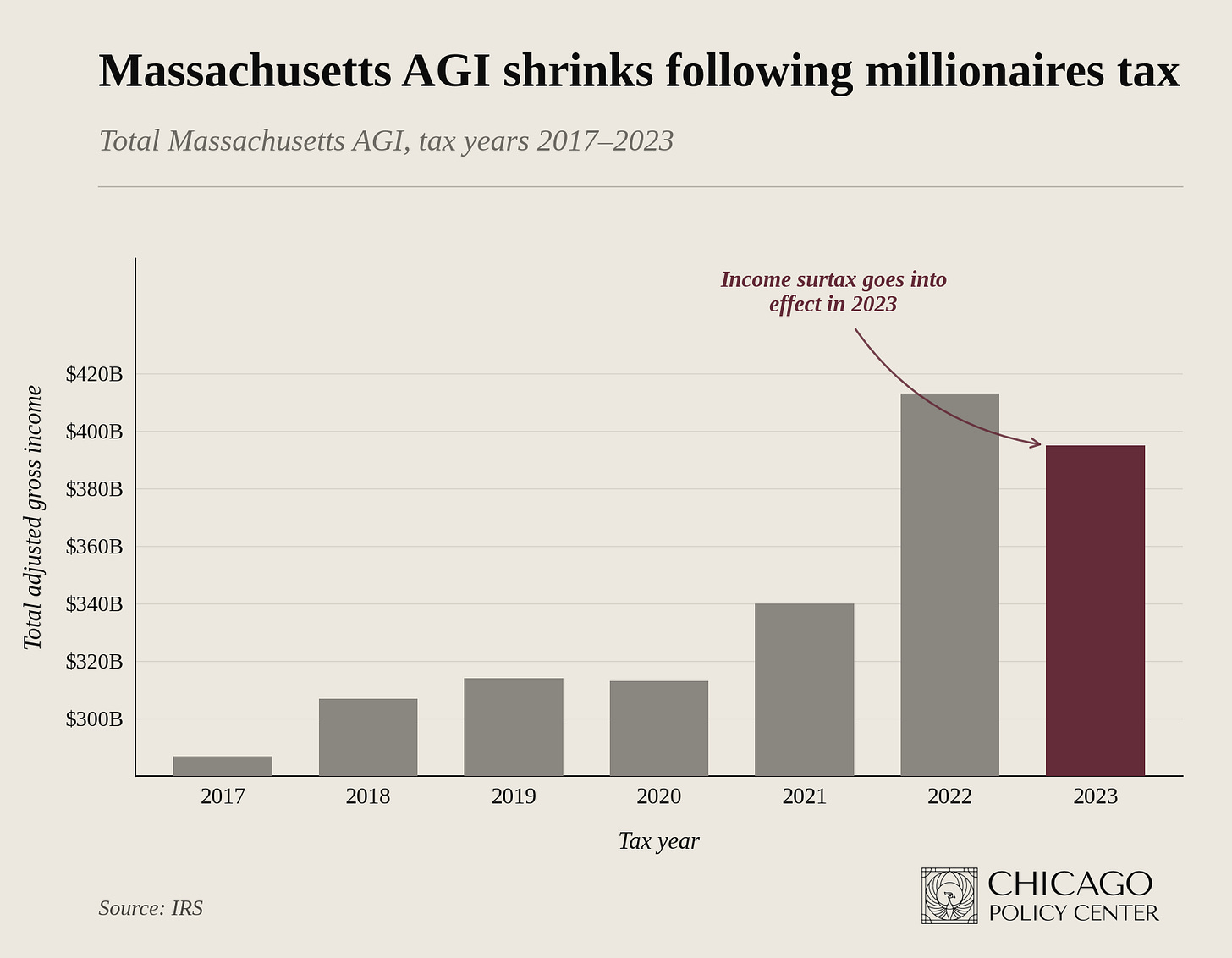
Massachusetts did get a sugar high of new tax revenue. But it came at the cost of shrinking the pie for everyone.
Illinois should not be copying this model.
May Day update: Mayor Brandon Johnson and the Chicago Teachers Union have failed to secure the school board votes necessary to make May 1 a non-attendance day. Thanks to all The Last Ward readers who contacted their school board member following last week’s newsletter!
New zoning chair: The Chicago City Council elected Ald. Gil Villegas as chair of the powerful Zoning Committee. His selection, compared with who Johnson wanted as chair (socialist Ald. Byron Sigcho-Lopez), is among the biggest swings in favor of healthier economic growth in Chicago this decade.
Villegas was a featured speaker at the Chicago Policy Center’s Charter Symposium at Northwestern’s Pritzker School of Law, and has been a champion of governance reform to make City Council a true legislative branch.
ShotSpotter update: The Last Ward was first to report on the connection between former Deputy Mayor of Community Safety Garien Gatewood’s firing and the severely delayed procurement process for a new gunshot detection technology to replace ShotSpotter. Now, City Council is demanding answers. Last week, 35 aldermen signed on to a new resolution demanding hearings “on status and reason for delays of Chicago Police Department’s procurement of [a] new records management system and appropriation for procuring [a] new acoustic gunshot technology system.”
Crisis Cast: I joined Thom Serafin and Lissa Druss on their podcast to talk about Illinois’ fiscal challenges and Chicago governance. (Apple Podcasts, Spotify)